


How to Develop a Reliable Backhand Serve
Step-by-step advice for a low, consistent backhand serve that puts pressure on opponents and sets up your doubles game.

Why the Backhand Serve Is Your Doubles Foundation
In doubles, the serve is not just a way to start the rally. It is your first chance to dictate where the rally goes. A low, reliable backhand serve takes the attack away from your opponents and gives your partner a chance to be aggressive at the net. In Leamington Spa club nights, where matches can turn on a single loose serve, players who can consistently land the shuttle just over the net and down the middle cause real problems. Get it right and you will win more cheap points, force weak returns and set your partner up for the kill.
Grip, Stance and Shuttle Contact
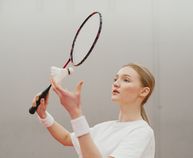
Start with a relaxed backhand grip. Place your thumb on the wider back of the handle and let your fingers wrap loosely around the rest. The grip should be soft enough that you can feel the racket head, but firm enough that it does not twist on contact. Stand close to the short service line, about a racket length behind it, with your racket foot forward. For a right-hander, that means the right foot leads. Your non-racket hand holds the shuttle by the tips of the feathers, roughly at waist height and slightly in front of your body.
Contact is everything. You want to strike the shuttle below waist height, with the racket shaft pointing downward. The power comes from a short, controlled push of the thumb and a gentle turn of the forearm, not from a big swing. Think of tapping the shuttle rather than hitting it. The ideal contact point is just in front of your leading foot, so the shuttle travels flat and low over the net.
The Step-by-Step Low Backhand Serve
- Set your feet: Stand with your racket foot forward, weight balanced, and your body still. Avoid leaning forward too much, as this makes it hard to keep the serve low.
- Hold the shuttle: Pinch the feather tips lightly. Do not grip the cork, as this makes the release inconsistent.
- Take aim: Pick a target just over the short service line, ideally the middle third of the court. In doubles, the middle is usually the safest and most awkward place for returners.
- Push, do not swing: Draw the racket back a few inches, then push through with your thumb. Keep the racket face almost flat and the follow-through short.
- Finish still: Hold your finish for a moment. A rushed follow-through often means a serve that drifts high or wide.
Common Faults and Quick Fixes
- Serve too high: Check your contact point. You are probably letting the shuttle drop too low before you hit it. Take it earlier and push flatter.
- Serve into the net: Your racket face may be too closed, or you are decelerating on contact. Push through the shuttle and aim a little higher over the net in practice.
- Inconsistent direction: Your shoulders are likely opening too early. Keep your non-racket shoulder pointing at your target and resist the urge to rotate.
- No disguise: If your flick looks different from your low serve, opponents will read it. Use the same backswing and body shape for both, changing only the speed and length of your push.
At a club in Leamington Spa, you will often play in sports halls with bright lights and unpredictable draughts. That makes a compact, repeatable action even more valuable. Keep your serve simple. The fewer moving parts, the better it holds up under pressure.
Practice Drills for Consistent Serving
You do not need a partner to improve your serve, but you do need a target. Place a cone, a spare shuttle tube or a towel just beyond the short service line. Serve twenty shuttles and count how many land in a two-foot zone. Aim for at least fifteen out of twenty before you move the target. Then practise serving to the middle, to the tramlines and to the receiver’s backhand.
- Ten-in-a-row: Serve until you land ten low serves in a row. If you miss, start again. This builds concentration and rhythm.
- Pressure serving: Give yourself a consequence for a missed serve, such as ten press-ups or a sprint to the back wall. It mimics match nerves.
- Flick variation: For every five low serves, add one flick. Keep the same preparation so your opponent cannot read it.
- Serve and return: Ask a partner to stand on the service line and return your serve. This gives you real feedback on which serves are hardest to attack.
Short, regular sessions beat long, occasional ones. Ten minutes at the start of a club night in Leamington Spa will pay off faster than an hour once a month.
Taking Your Serve into Match Play
In doubles, your serve should set up your partner. If you serve low and straight, your partner can take the net and look for the interception. If you serve to the middle, you cut down the returner’s angles and create confusion between opponents. Mix in the occasional flick to the backhand corner, but only when you are confident. A weak flick is an easy smash for a good opponent.
Remember that the best serve is the one you can repeat when you are nervous, tired or playing on an unfamiliar court. Whether you are competing in a local league match or just enjoying a social game in Leamington Spa, a reliable backhand serve gives you a calm, professional foundation. Practise it until it feels boring. Boring serves win doubles matches.
Post a comment