


Simple Ways to Improve Your Overhead Clear
Coaching tips on preparation, contact point and follow-through to add power and consistency to your basic overhead clear.

Why the Overhead Clear Still Matters
Spend an evening at a badminton club in Leamington Spa and you will notice something interesting. Plenty of players can hit a decent smash, but far fewer can hit a convincing overhead clear. It is the least glamorous shot in the game, yet it is the one that keeps you out of trouble. A deep, high clear pushes your opponent to the back of the court, gives you time to recover to the middle and creates the space for your drop shots and smashes to actually work.
If your clear keeps landing short, or your shoulder aches after two games, the problem is almost never a lack of muscle. It is nearly always technique. Three areas — preparation, contact point and follow-through — account for most of the power and consistency you are looking for. Fix those and you will feel the difference within a few club sessions.
Prepare Early and Get Side-On
The overhead clear is won or lost in the half-second before you swing. Most club players arrive under the shuttle too late, too square to the net and with their racket somewhere near their knees. From that position, no amount of effort will produce a clean, powerful shot.
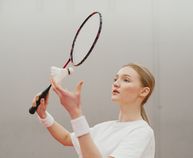
Turn side-on as soon as you see the shuttle travelling towards a corner. Your non-racket arm points at the incoming shuttle and your racket arm comes up behind your head, so the racket is already high. Think of drawing a bow: the non-racket arm aims, the racket arm is the string being pulled back. Get there early enough to take a small adjustment step rather than a desperate lunge.
- Grip: relaxed basic grip, not a tight fist. Tension in the hand kills racket-head speed.
- Racket up: keep the racket head above shoulder height as you move — it shortens the journey to the shuttle.
- Feet: push off the back foot, land on the racket foot, then scissor kick to bring you back towards the middle.
Contact the Shuttle High and in Front
Where you meet the shuttle matters more than how hard you swing. Aim for a contact point high above your racket shoulder and slightly in front of your body. If the shuttle is behind your head, or dropping below shoulder height, you will end up pushing it rather than hitting it.
At contact, your arm should be almost straight, not bent at the elbow. Reaching up fully adds several inches of height, and height translates directly into a steeper, deeper clear. Keep your eyes on the shuttle until the strings make contact; your head stays up, your chest stays open, and the shot travels further almost automatically.
The racket face should be slightly open rather than flat. A touch of backward tilt sends the shuttle up and deep instead of flat and long — a small adjustment that is the difference between a clear that sails over your opponent and one that flies out the back.
Let the Follow-Through Do the Work
Power in badminton comes from rotation, not from the arm alone. As you swing, your hips and shoulders turn, your elbow leads, and your forearm rotates so the racket face finishes across your body. This rotation is where the easy power lives.
Resist the temptation to flick your wrist hard at the last moment. Snappy actions feel powerful but are inconsistent and put strain on the forearm and shoulder. Instead, relax the arm, accelerate smoothly through contact and let the racket finish down near your opposite hip. If you stop the swing halfway, you are leaving power on the table.
Notice your recovery, too. A good follow-through naturally brings your racket foot forward and your body back towards the middle. If you finish the shot leaning backwards with your feet stuck, the next shot will be a struggle.
Quick Fixes for Common Faults
- Clear lands short: you are hitting the shuttle too low or with a bent arm. Get there earlier and reach up.
- Shuttle flies flat and long: the racket face is too square. Open it slightly and aim higher over your opponent's head.
- Shoulder or elbow pain: gripping too tightly and snatching at the shuttle. Loosen the grip and swing smoothly.
- No time to prepare: you are watching the shuttle too long before moving. Split-step as your opponent strikes and move on the first sign of direction.
Drills Worth Doing at Club Training
Technique improves fastest with repetition, so build a few drills into your next session. Ask a partner to feed you high shuttles to alternate corners while you focus on one thing at a time — first the turn and racket-up position, then the high contact, then the follow-through. Ten minutes of focused feeding beats an hour of aimless rallying.
Hitting against a wall is also surprisingly effective. Stand a few metres back, throw a shuttle at the wall and clear it repeatedly, keeping your racket high between shots. Finally, play half-court clears with a partner and count how many you can keep landing past the back service line. That simple target turns a warm-up into a genuine test of your basic shot.
Most clubs in Leamington Spa welcome visitors and run coaching evenings where a coach can watch your clear for five minutes and identify the one fault holding you back. A higher, deeper overhead clear will not just win you more rallies — it will make every other shot in your game easier to play.
Post a comment