


Mastering the Drop Shot from the Rear Court
Learn how to disguise a soft drop shot, control the net cord and move forward to pressure your opponent.

Leamington Spa's badminton clubs are full of players who can smash hard from the back. But the real point-winners are those who change pace. The drop shot from the rear court looks like a smash, sounds like a smash, yet lands softly just over the net. Master it and you force your opponent to scramble forward, opening the court for your next attack. This guide covers the three keys: disguise, net cord control, and the forward movement that turns a good drop into a winning rally.
The Art of Disguise: Grip and Preparation
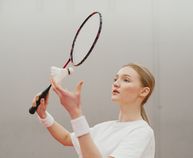
The best drop shots are indistinguishable from a smash or clear until the last moment. That means identical preparation. Use the same grip as for a smash – forehand for forehand, backhand for backhand. Keep your racket arm relaxed but ready. As you move back, turn your shoulders and raise your racket as if to smash. Your non-racket arm points up at the shuttle for balance.
At local club nights, you will see players telegraph their drop by slowing the racket early. Avoid that. Keep your racket head speed high until contact. The deception comes from your opponent being unable to read your intention. Practise shadow swings in front of a mirror so your preparation for drop, clear, and smash looks the same. Only the final wrist action differs.
Timing and Body Language: Selling the Smash
Contact point is crucial. Take the shuttle slightly in front of you, at a similar height to a smash. Use a gentle squeeze of the fingers at impact, not a big swing. Think caress, not hit. Your body language should scream smash: chest facing the net, racket high, eyes on the shuttle. A common mistake is dropping the elbow or opening the racket face early – that gives the game away. Use a short, sharp backswing, then accelerate into the shuttle before slowing right at contact. This late deceleration creates the disguise. Watch the best players at your club – their drop looks identical to their smash until the shuttle leaves the strings.
Controlling the Net Cord: Touch and Trajectory
A drop that lands mid-court is a gift. Aim to make the shuttle tumble over the net cord and land close to the net. The trajectory should be flat enough to clear the net but steep enough to drop quickly. Target a point 30–60 centimetres past the net on your opponent's side.
String tension matters. Lower tension gives a trampoline effect, making soft shots harder to control. Many coaches recommend medium tension for learning the drop. The stroke is a gentle push, with a slight slicing action for a reverse drop. Focus on the net cord, not the floor – aim too low and you hit the net. A good drill: stand at the rear court and try to land the shuttle on a target just over the net. Repeat until you can do ten in a row.
Moving Forward: The Follow-Through That Wins Points
The drop is only half the battle. The moment you hit it, move forward. Too many players admire their shot and get stuck at the back. Use the momentum of your stroke to push off and move towards the net. Take two or three quick steps, then split step as your opponent hits. Keep your racket up and in front.
Your goal is to intercept any weak return – a net shot, a lift, or a push. By pressuring the net, you force your opponent to lift (giving you another attack) or try a delicate net shot you can kill. Remember: drop and move. In doubles, this is a rotation drill; in singles, it separates good from great.
Practice Drills for Leamington Spa Players
You do not need a fancy court to improve. Try these at your local club or sports centre:
- Shadow drop and move: Without a shuttle, practise rear court preparation, disguised drop, then three quick steps forward and a split step. 10 reps per side.
- Multi-shuttle feeding: A partner feeds to your rear court. Hit a drop, move forward, tap a net shot. Repeat for 2 minutes, then swap.
- Target practice: Place a cone just over the net. From the rear court, aim to land the shuttle on it. Count successes out of 20.
- Conditioned game: Play half-court singles where you must hit a drop from the rear court before you can win a point.
Many local clubs run weekly coaching sessions where you can work on these skills with a qualified coach. The key is repetition and feedback. Ask a partner to watch your preparation and tell you if they can read your drop. With time, your drop shot becomes a reliable weapon that opens the court and leaves opponents guessing.
Post a comment